There is a quiet frustration that almost every travel agency owner carries — but rarely talks about publicly.
You design beautiful itineraries. You build strong ground teams. You negotiate hotel contracts. You answer inquiries at midnight because a traveler from another time zone has questions. You deliver memorable experiences that people talk about for years.
And then, when the booking happens, 20–30% of your margin disappears into OTA commissions.
You scroll through your monthly report and see a painful pattern: high revenue on paper, low profit in reality. Worse, your customer remembers the OTA platform — not your brand. The relationship belongs to someone else.
This is the OTA commission problem, and in 2026, it is one of the biggest structural threats to travel businesses.
The agencies that are growing profitably today have figured out something important: you don’t eliminate OTAs overnight — but you build an independent acquisition channel that gives you control.
That channel is search.
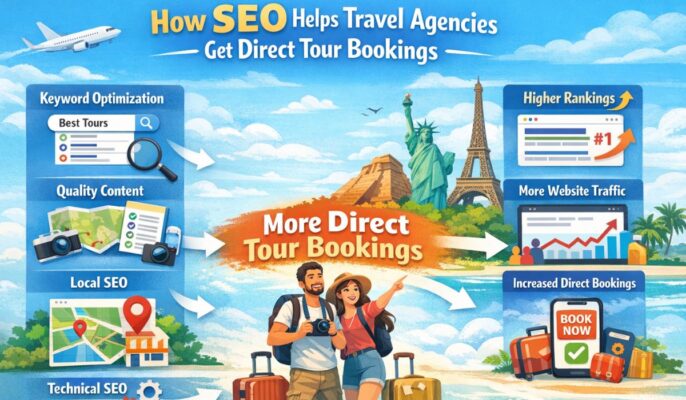
This article explains, in depth, How SEO Helps Travel Agencies Get Direct Tour Bookings, and how it transforms a travel website from a brochure into a booking engine.
The Core Challenge: Why Most Travel Agencies Struggle With Direct Bookings
Travel is one of the most competitive digital industries. Large OTAs invest heavily in paid ads, SEO, brand campaigns, and remarketing. They dominate generic search results like “Rajasthan tour package” or “Golden Triangle tour.”
As a result, many travel businesses feel that ranking organically is impossible.
However, that assumption is flawed.
What I’ve seen repeatedly while consulting with tour operators and destination management companies is this: most agencies don’t lose because OTAs are unbeatable — they lose because their travel website ranking strategy is unclear or incomplete.
Their website often suffers from:
- Thin content with no depth
- Generic package descriptions copied from competitors
- No content strategy for tours
- Weak internal linking
- No authority signals
- Poor local SEO
- No structured conversion funnel
Google’s 2026 algorithm updates — especially those aligned with E-E-A-T (Experience, Expertise, Authoritativeness, Trustworthiness) and Helpful Content — reward depth, originality, and genuine expertise. OTAs win generic battles, but they struggle to demonstrate local, on-ground expertise the way specialized agencies can.
That is your opportunity.
How SEO Helps Travel Agencies Get Direct Tour Bookings
Search engine optimization is not just about rankings. It is about visibility at the exact moment a traveler is making a decision.
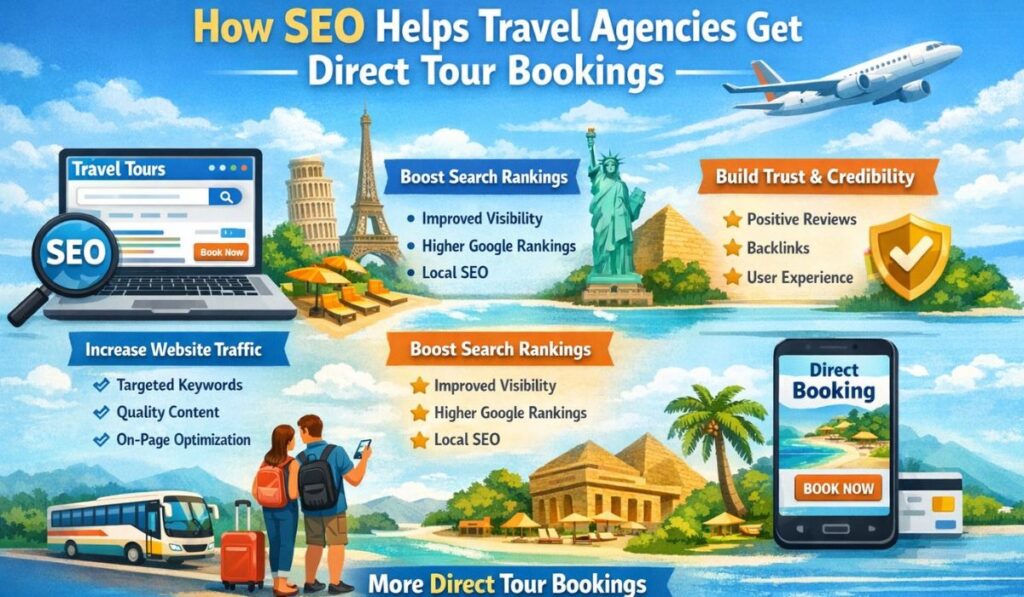
When done strategically, SEO accomplishes four core objectives:
- Brings high-intent organic traffic
- Builds brand authority
- Improves trust and credibility
- Converts visitors into direct bookings
Let’s break this down step by step.
1. SEO Brings High-Intent Organic Traffic for Travel Business
The most powerful difference between SEO and many other marketing channels is intent.
When someone searches:
- “7 days Rajasthan private tour cost”
- “Is Jaipur safe for solo female travelers?”
- “Best time to visit Agra in October”
- “Luxury Golden Triangle tour with driver”
They are not passively browsing. They are actively planning.
Through a structured SEO content strategy for tours, your agency can rank for:
- Informational queries (research stage)
- Commercial queries (comparison stage)
- Transactional queries (booking stage)
Unlike paid ads, organic traffic does not disappear when your budget pauses. Once a page ranks well, it can generate consistent inquiries month after month.
More importantly, organic traffic for travel business tends to convert better because the user discovered you during their research journey, not through interruption.
2. SEO Builds Brand Authority Before the Booking Decision
Travel is a high-trust purchase. People are not just buying a product; they are buying safety, experience, and peace of mind.
Google’s E-E-A-T framework increasingly favors content that demonstrates:
- First-hand destination experience
- Transparent company information
- Clear expertise
- Helpful, in-depth explanations
When your website consistently publishes:
- Detailed destination guides
- Real itinerary breakdowns
- Cultural insights
- Seasonal travel advice
- Visa and safety guidance
You position yourself as a specialist, not just a seller.
This authority-building process directly impacts how SEO helps travel agencies get direct tour bookings. Travelers who read your in-depth guide are far more likely to trust you than someone clicking a generic OTA listing.
Authority shortens the decision cycle.
3. SEO Reduces Dependency on the OTA Commission Model
The OTA commission problem is fundamentally a margin problem.
If you pay 20% commission on a ₹1,50,000 tour, that is ₹30,000 gone. Over 100 bookings, that becomes substantial.
SEO investment, on the other hand, builds a long-term digital asset. While it requires consistent effort and professional execution, it does not charge per booking.
Over time, the cost per acquisition through SEO becomes significantly lower than OTA commissions.
Agencies that successfully get direct tour bookings without OTAs typically follow a simple logic:
- Use OTAs for exposure
- Use SEO to build independence
- Gradually shift booking ratio toward direct channels
This transition increases profitability without increasing pricing.
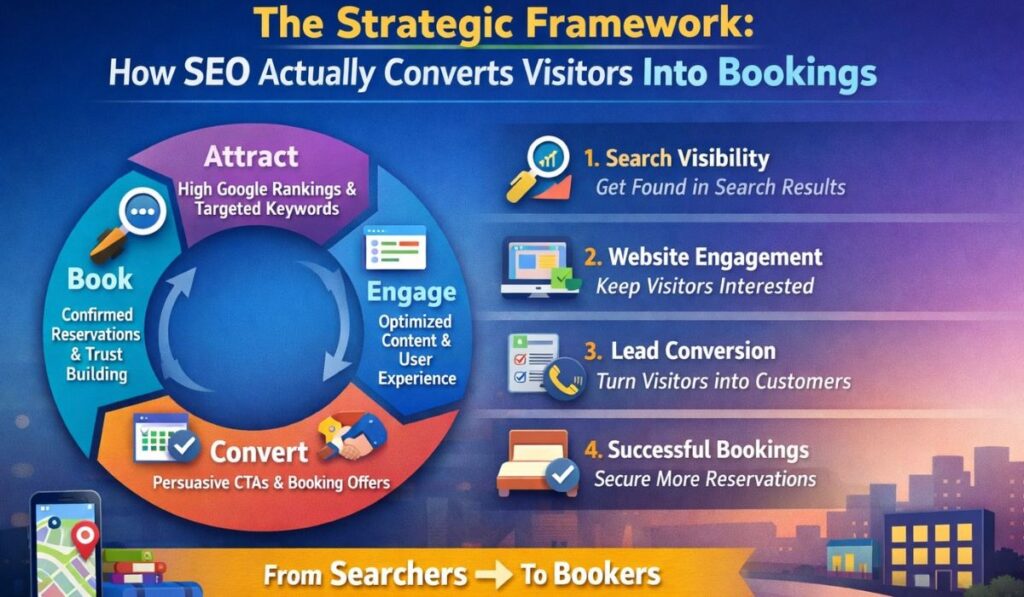
The Strategic Framework: How SEO Actually Converts Visitors Into Bookings
Ranking alone is not enough. Conversion is where revenue happens.
Here is how a complete system works.
Stage 1: Visibility Through Content Depth
A traveler searching “best Rajasthan itinerary for 10 days” lands on your comprehensive blog guide.
Inside that blog:
- You provide a real route plan.
- You share local insights.
- You explain seasonal considerations.
- You link internally to your 10-day Rajasthan tour service page (anchor text suggestion: “10-day Rajasthan private tour package”).
This internal linking structure is critical. It transfers trust from informational content to commercial pages.
Stage 2: Trust Building Through Experience Signals
Your service page should include:
- Detailed inclusions and exclusions
- Transparent customization options
- Testimonials
- Real photographs
- Clear contact information
- FAQ schema
This improves both user confidence and search visibility.
This is where travel conversion optimization plays a key role. Clear calls-to-action, fast loading speed, mobile optimization, and structured layout dramatically impact booking rates.
Stage 3: Conversion Through Clarity and Positioning
Most agencies make one major mistake: they focus too much on features and not enough on reassurance.
Travelers ask:
- Is this safe?
- Will I be supported?
- What if plans change?
- Is this worth the money?
SEO content must answer these emotional concerns. When it does, direct bookings increase naturally.
Local SEO for Tour Operators in India
For Indian travel agencies, local SEO for tour operators is an underutilized goldmine.
When someone searches:
- “Best travel agency in Delhi”
- “Rajasthan tour operator near me”
- “Agra private tour company”
Google prioritizes local results.
Optimizing your Google Business Profile for travel agencies is essential:
- Accurate business details
- Updated photos
- Regular posts
- Real reviews with responses
- Category optimization
In addition, local citations, consistent NAP details, and location-specific landing pages (e.g., “Delhi-based Golden Triangle tour operator”) significantly improve visibility.
For destination management companies, this local presence signals authenticity.
Many agencies ignore this channel, yet it often produces highly qualified inquiries.
Travel Agency Digital Marketing: SEO vs Paid Ads for Travel Agencies
Paid ads are not bad. In fact, they are useful for seasonal pushes and immediate lead generation.
However, comparing SEO vs Paid Ads for travel agencies reveals important strategic differences.
Paid Ads:
- Immediate visibility
- Requires continuous budget
- High cost in competitive markets
- Lower perceived trust
SEO:
- Slower initial growth
- Long-term compounding returns
- Builds authority
- Higher trust factor
The smartest agencies use a hybrid model:
- Paid ads for short-term campaigns
- SEO for long-term stability
But those who rely only on ads face a dangerous scenario: the moment ad spend drops, inquiries stop.
SEO builds a foundation.
Travel Agency Online Marketing 2026: What Actually Works
In 2026, Google prioritizes helpful, human-centered content over AI-generated fluff.
Successful travel agency online marketing 2026 strategies include:
- Long-form destination guides (1,500–3,000 words)
- FAQ-rich itinerary pages
- Structured internal linking
- Schema markup
- Author pages with real credentials
- Transparent company details
Search intent optimization is critical. Every page must align with what the user expects to see.
If someone searches for a “private Golden Triangle tour,” they want itinerary, price range, inclusions, and trust signals — not a generic homepage.
Common SEO Mistakes Travel Agencies Make
From consulting experience, these are recurring mistakes:
First, copying competitor content. Google identifies similarity easily. Originality wins.
Second, writing thin 400-word package descriptions. Depth builds authority.
Third, ignoring blog content entirely. Without informational content, you miss early-stage travelers.
Fourth, no internal linking. Pages exist in isolation.
Fifth, expect results in 30 days. SEO is a strategic investment, not a shortcut.
When corrected, performance improves significantly within months.
Content Marketing for Tours: The Authority Engine
A strong SEO content strategy for tours includes:
- Destination guides
- “Best time to visit” articles
- Safety and travel tips
- Budget vs luxury comparisons
- Sample itineraries
- Cultural insights
Each blog should internally link to related packages. For example:
A blog titled “Best Time to Visit Jaipur in 2026” should link to:
- Jaipur sightseeing tours
- Rajasthan tour packages
- Luxury Rajasthan private tours
This builds topical authority and improves overall site rankings.
Content marketing fuels direct bookings indirectly — by nurturing trust before sales.
Long-Term ROI of SEO for Travel Agencies
SEO is cumulative.
Each article, each backlink, each optimized page adds authority to your domain.
Unlike paid campaigns that reset monthly, SEO compounds.
Over a 2–3 year period, agencies that consistently invest in SEO often see:
- Reduced customer acquisition cost
- Higher direct booking ratio
- Stronger brand recall
- Increased inquiry quality
This is how SEO helps travel agencies get direct tour bookings sustainably — not temporarily.
Action Plan: A Practical Roadmap
If you are serious about building independence from OTAs, here is a structured path:
First, audit your website technically and strategically.
Second, map keywords based on search intent.
Third, build pillar content for main destinations.
Fourth, optimize service pages with depth and conversion clarity.
Fifth, implement structured internal linking.
Sixth, optimize Google Business Profile and local signals.
Seventh, build backlinks through collaborations and guest contributions.
This is not overnight work — but it is scalable and measurable.
Conclusion: Build an Asset, Not Just Traffic
OTAs will continue to exist. Paid ads will remain competitive. Algorithms will evolve.
But one truth will remain constant:
If your website ranks organically, builds authority, and answers traveler questions better than competitors — you will win direct bookings.
SEO is not just about traffic. It is about ownership.
Ownership of visibility.
Ownership of customer relationships.
Ownership of margins.
If you want sustainable growth in 2026 and beyond, investing in structured, experience-driven SEO is no longer optional.
It is strategic infrastructure.
FAQs
1. How long does SEO take to generate direct bookings?
Typically 4–6 months for noticeable traction, and 8–12 months for strong, consistent booking growth, depending on competition and execution quality.
2. Can small travel agencies compete with large OTAs?
Yes, by targeting niche and long-tail queries where expertise and local knowledge matter more than brand size.
3. Is SEO better than paid ads for travel agencies?
SEO is better for long-term growth and authority. Paid ads are useful for short-term campaigns. A balanced strategy works best.
4. Does blogging really increase direct bookings?
Yes, when blogs answer real traveler questions and strategically link to relevant tour pages.
5. What is the biggest mistake in travel SEO?
Publishing thin, generic content without a clear search intent strategy.
About the Author
WebInfoLab – A results-driven digital marketing agency specializing in SEO and performance marketing for travel agencies. Visit https://www.webinfolab.com/ to learn more.